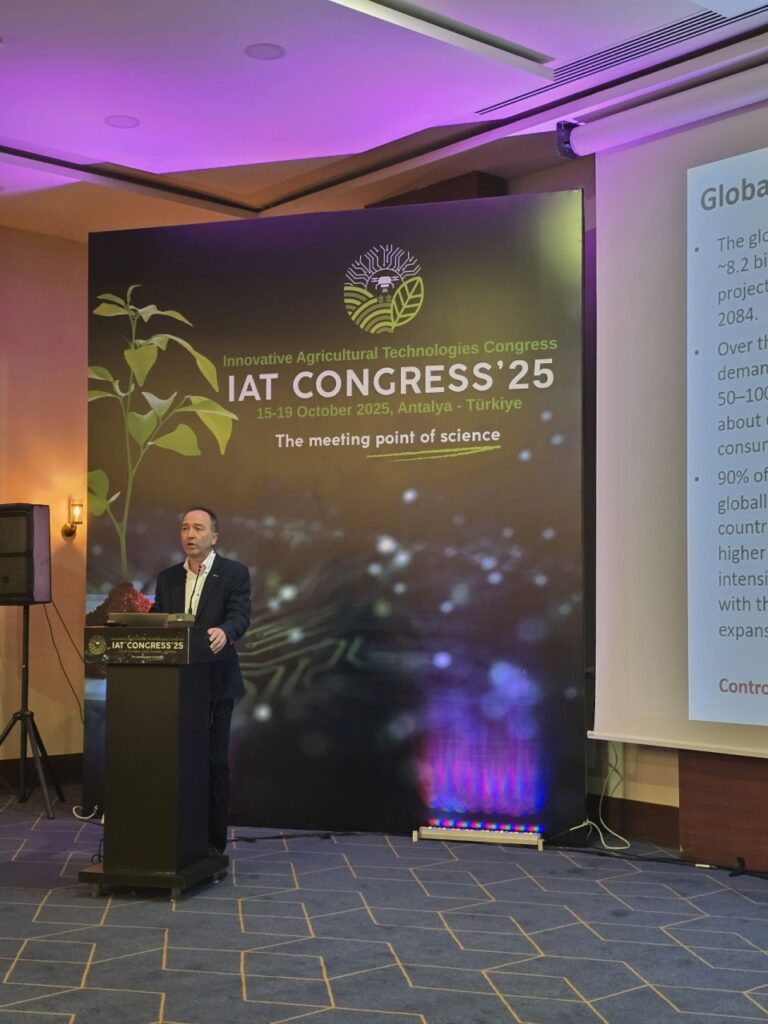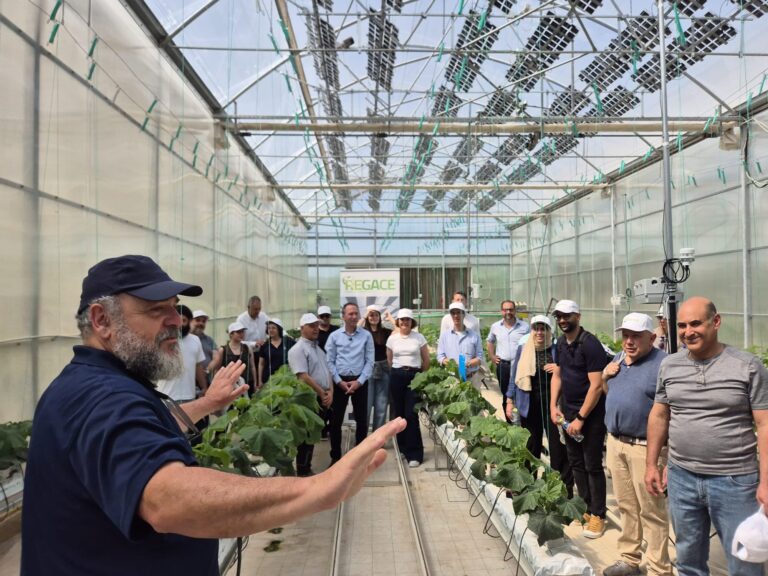
The EU funded REGACE Project reached an important milestone with its final conference, bringing together farmers, policymakers, researchers, and energy experts from Europe, Asia and Africa to explore how greenhouse agrivoltaics cam be a practical, scalable solution with global relevance.
Held online on January 29, the conference and accompanying webinar, Agrivoltaics in Greenhouses: Turning Sunlight into Energy and Crops, showcased how existing greenhouse infrastructure can play a major role in meeting renewable energy targets while protecting food production and farmers’ livelihoods.
Turning greenhouses into energy assets
As the European Union accelerates its renewable energy ambitions, solar power sits at the heart of the transition. REGACE research demonstrates that installing photovoltaic panels on existing greenhouse structures could deliver around 23 percent of the solar capacity needed across Europe, provided sufficient investment is in place.
What makes this approach especially compelling is that it does not compete with agriculture for land. Studies presented during the conference highlighted that relying mainly on ground-mounted solar systems could require up to two percent of farmland in some countries to meet 2030 energy goals.
By contrast, greenhouse agrivoltaics generates clean energy using infrastructure that is already there, resulting in almost zero additional land use. This message resonated strongly as the globe faces the challenge of balancing food security, climate action, and land availability.
Strong results across diverse regions
While REGACE is an EU-funded project, the conference made clear that its findings extend far beyond Europe. Modelling results shared during the webinar showed that in countries such as Israel, Romania, and Croatia, greenhouse-based photovoltaic systems could supply more than 40% of the solar capacity required by 2030. Across Europe as a whole, the average contribution stands at 23%.
These figures underline a key point discussed throughout the event: regions with strong greenhouse sectors and high solar potential stand to benefit the most. This applies not only to Europe, but also to parts of the Middle East, Africa, and other regions where protected agriculture is expanding and energy demand is rising.
Lower emissions, lower costs
Another central theme was efficiency. Traditional open field agrivoltaic systems often rely on heavy steel structures and concrete foundations, which increase both costs and carbon footprints.
REGACE greenhouse agrivoltaic systems take a different approach by reusing existing greenhouse frames. As presented during the conference, this reduces iron use from 103 kilograms per kilowatt to just 48 kilograms. As a result, the carbon footprint drops from 196 to 84 kilograms of CO2 per kilowatt. Investment costs are reduced by around 24 percent compared with conventional ground-mounted systems.
Supporting farmers
Speakers at the final conference emphasized the human dimension. Greenhouse agrivoltaics allows farmers to diversify income streams by producing both food and energy, without compromising crop yields. In some cases, integrated photovoltaic systems can even improve growing conditions by moderating light and temperature.
“As Europe searches for solutions that support both food security and climate goals, greenhouse agrivoltaics stands out as a practical and scalable option,” said REGACE coordinator Dr. Ibrahim Yehia of the Alzahrawy Society. “REGACE proves that we can turn existing agricultural infrastructure into clean energy assets, while keeping farms productive and resilient.”