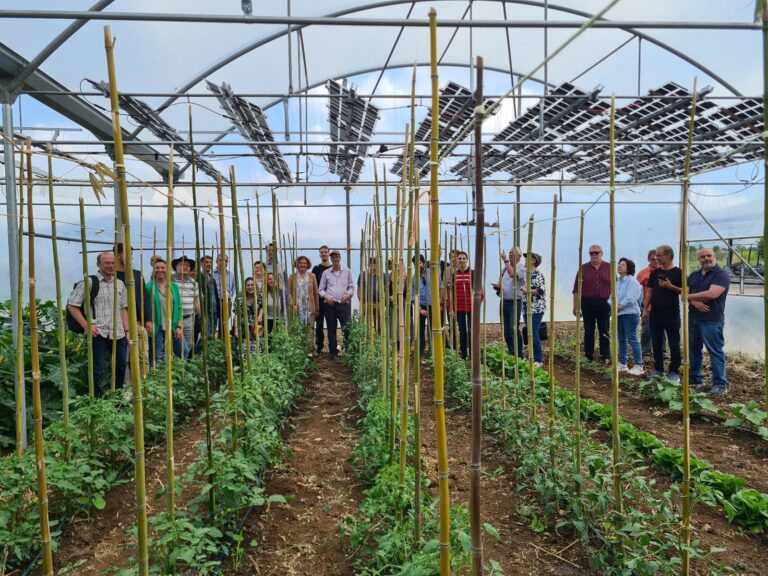
Across Europe and beyond, countries are pushing hard to accelerate renewable energy while protecting their food systems. These goals often compete, especially as ground mounted solar installations require large areas of land that could otherwise grow crops.
The EU-funded REGACE project is exploring a different approach. Instead of choosing between food and energy, the project demonstrates how greenhouses can generate clean electricity and continue to produce food efficiently.
The recently completed Environmental Impact Report from REGACE provides strong evidence that integrating photovoltaic panels into greenhouse structures can deliver meaningful renewable energy generation and climate benefits, while maintaining viable agricultural production.
The findings come from field trials, farmer surveys, economic analysis, and environmental modelling across five partner countries: Israel, Greece, Austria, Italy, and Germany.
Greenhouses Turn Into Energy Producers
Solar power targets across Europe are rising rapidly. According to the study, meeting the 2030 solar goals set by EU strategies could require significant land if countries rely mostly on traditional ground mounted PV. In fact, estimates show that meeting national solar targets with these systems could occupy one to two percent of farmland in some countries.
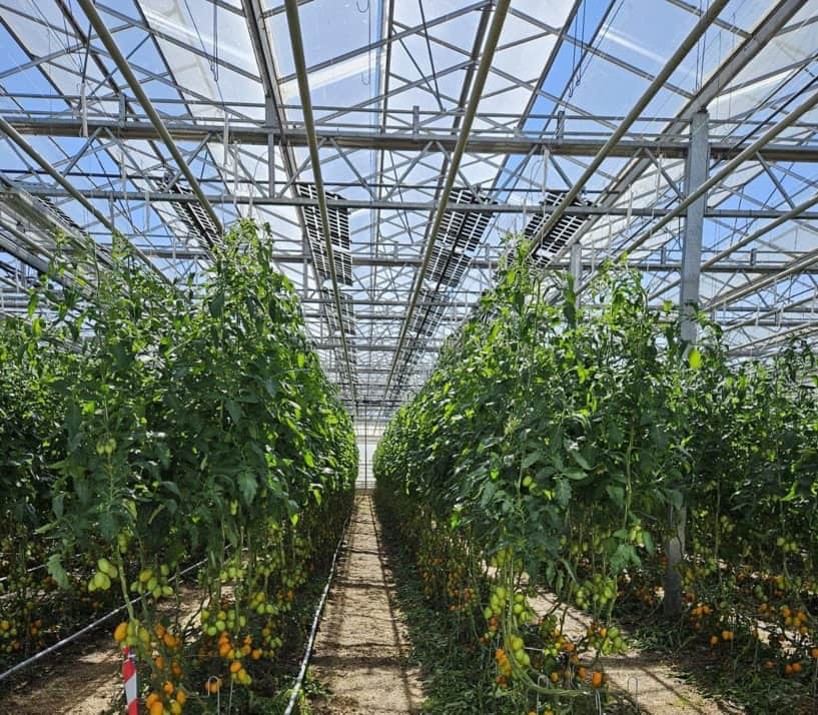
REGACE presents a more efficient alternative. Because panels are mounted on existing greenhouse structures, the land footprint is almost zero. The power density achieved across REGACE greenhouses averaged 0.396 MW per hectare.
In practice, this means that a commercial greenhouse can generate enough renewable electricity to cover all or most of its own electrical needs throughout the year. In warmer climates, where heating demand is lower, PV electricity can exceed consumption. In colder climates, PV still covers a meaningful part of total energy use, helping to reduce the need for fossil-based energy.
Energy Production & Crop Performance
At the national scale, the modelling shows that agrivoltaics in greenhouses could make a real contribution to renewable energy targets. In countries such as Israel, Romania, and Croatia, greenhouse-based PV could supply more than 40% of the solar capacity needed by 2030. Across Europe, the average potential contribution reaches about 23%. These shares represent a significant opportunity to meet future energy needs without expanding land use.
Importantly, farmer surveys from Israel provide a more nuanced picture based on commercial experience. Two thirds of interviewed growers reported no major impact on yields after installing PV. Most farmers also noted no meaningful change in produce quality, pest levels, or irrigation needs.
Lower Carbon & Resource Footprint
One of the clearest advantages of greenhouse-based PV is its reduced environmental footprint compared to open field agrivoltaics. In traditional systems, steel structures and concrete foundations are among the largest contributors to carbon emissions. The study shows that open field agrivoltaic structures use around 103 kilograms of iron per kilowatt, which results in about 196 kilograms of CO2 emissions per kilowatt.
Under REGACE, the panels are mounted directly on the greenhouse frame. This cuts material use almost in half. The mounting structure uses only 48 kilograms of iron per kilowatt, resulting in a carbon footprint of about 84 kilograms of CO2 per kilowatt. Investment costs are also lower. Open field agrivoltaic systems average 1,200 euro per kilowatt, while REGACE greenhouse systems cost about 912 euro per kilowatt (24% less).
When combined with on-site renewable energy generation, these savings contribute to a stronger climate performance. Modelling shows that supplying just 20% of greenhouse energy demand with PV power can reduce total on farm emissions by as much as seven percent in some partner countries.
The REGACE Environmental Impact Report shows that greenhouses can play a bigger role in the clean energy transition. By integrating solar technology into structures that already exist, growers can reduce energy costs, cut emissions, and support national renewable energy goals. At the same time, the agricultural side remains viable, especially when supported by crop specific management strategies.
As Europe continues to look for solutions that support both food security and climate goals, agrivoltaics in greenhouses offers a practical and scalable path. REGACE brings evidence that this approach is not only possible, but beneficial for farmers, the energy system, and the environment.