The scientific publications of the REGACE Project can be found on the Zenodo open access repository,here: https://zenodo.org/
The research paper titled “Flexible photovoltaic generation strategy for Rome Technopole” was published on March 19, 2026 in Energy Conversion and Management: X.
The study, developed by REGACE Project researchers from the University of Rome Tor Vergata and Italy’s Rome Technopole innovation ecosystem, explores how energy-flexible photovoltaic systems with battery storage can meet the future campus’s electricity demand.
Through load modeling, solar-climate simulations, and system optimization, the authors identify an effective configuration of 9.5 MWp of PV and 16.8 MWh of storage, with 30° south-facing panels, to support reliable renewable electricity supply.
A financial assessment shows that 65% self-production is already economically viable today, while higher self-generation levels become more attractive as technology costs decline.
Overall, the paper presents a practical pathway toward resilient, cost-effective campus energy autonomy through smart solar-plus-storage integration.

The journal Energy published the research paper “An accurate data-driven physical model for bifacial PV power estimation” in Volume 340 on 15 December 2025. The paper is authored by Ali Sohani, Marco Pierro, Gianluigi Bovesecchi, David Moser, and Cristina Cornaro.
This study introduces the DBPG2 model, a new physical data-driven approach for estimating bifacial PV power output more accurately and with fewer input requirements than common simulation methods.
Unlike conventional approaches, it does not require rear tilted irradiance, albedo, or module bifaciality coefficient, and it was tested across multiple real-world systems in Denmark, Finland, the United States, and Italy.
Overall, the results show that DBPG2 generally outperforms PVlib, especially in high-albedo environments and single-axis tracking systems, where bifacial PV systems often operate most effectively.
The paper’s main contribution is a more practical and generalizable modeling method for bifacial PV performance estimation.

The study “Innovazione tecnologica e partecipazione: prospettive sociologiche sul ruolo delle tecniche partecipative nell’adozione di pannelli fotovoltaici in agricoltura,” authored by Andrea Volterrani and Maria Cristina Antonucci within the REGAE Project, was published in Culture della sostenibilità (No. 35, 2025).
The paper explores how participatory methods can support the adoption of agrivoltaic solutions. Rather than relying on top-down technology rollouts, it argues that early and active involvement of farmers and local communities is essential for building trust, acceptance, and long-term value.
Drawing on recent sociological and innovation research, the article highlights co-creation as a practical way to make agri-photovoltaics more inclusive and sustainable.
The early findings from REGACE suggest that community participation in the planning and design phase can strengthen adoption and help distribute social and economic benefits more equitably across the agricultural sector.

The REGACE Project researchers authored this study report entitled, The electrical performance of a single-axis sun tracking agrivoltaic system inside a polytunnel greenhouse, which was published in the journal of Energy Conversion and Management: X, Volume 26, April 2025.
The scientific paper tracked the system’s performance from May to October and found that it could achieve a peak output comparable to standard outdoor PV systems in the Mediterranean climate (around 5.5 kWh/kWp). However, the greenhouse environment did present challenges. The greenhouse covers and seasonal dust reduced the amount of sunlight reaching the panels, limiting overall performance.
Despite these limitations, the tracking system still provided a significant boost in energy output (15-20%) compared to a fixed PV system inside the same greenhouse. The capacity factors were a bit lower than outdoor systems, likely due to partial shading and more diffuse light conditions inside. The performance ratio was also lower, specifically in July, again pointing to the impact of being inside the greenhouse.
The research highlights the promising potential of integrating agrivoltaics within greenhouses for energy generation, while also acknowledging and quantifying the specific challenges that need to be considered due to the unique environmental conditions inside. It suggests that while effective, these systems face different limitations compared to traditional outdoor installations.
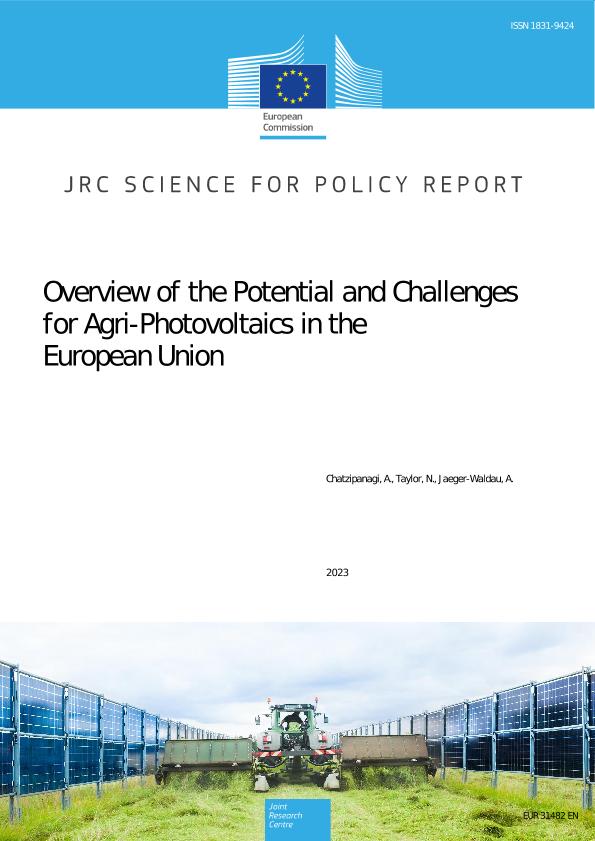
A new Science for Policy report by the Joint Research Center (JRC) concluded that Agri-Photovoltaics (Agri-PV) has the potential of contributing significantly to the EU energy transition without occupying additional land but by bringing advantages to the already existing agricultural activities.
Agri-PV manages to combine two very important activities of the modern world; electricity and food production with limited impacts of one on the other.
The study, entitled, overview of the potential and challenges for Agri-Photovoltaics in the European Union, maps the current situation in relation to the definition of Agri-PV and to related standards and guidelines, and draws attention to the challenges faced by developers.
The report mentions that Agri-PV is directly supported by the European Commission (EC) with a budget of 10 million Euro that funded three EU projects: PV4Plants, REGACE and SYMBIOSYST.
SolarPower Europe Agrisolar Best Practices Guidelines
REGACE was included in SolarPower Europe’s Agrisolar Best Practice Guideline’s second volume. The project was praised for presenting innovative agrivoltaics (Agri-PV) technology.
In the guidelines, SolarPower Europe praises the “radical innovative technology” REGACE, saying it will demonstrate “Agri-PV’s potential to become a major contributor to the EU clean energy portfolio.”
“The REGACE solution will be highly competitive compared to other solutions, as it will fully address the desired destination impact of clean, affordable energy. The system demonstrated in this project will also be cost effective in areas with less sunshine,” according to the guidelines.
“In addition to the economic impact, this will also lead to a significant positive effect on ecological-environmental sustainability and reduced ecological footprint through its life-span maintenance and operation,” the guidelines conclude.
Agrisolar offers a complete solution with multiple economical, social, and environmental benefits. It effectively brings together two major sectors of our society and economy: agriculture and energy. Land is used for both agricultural production, and for photovoltaic (PV) power generation. With agriculture being particularly vulnerable to climate change, solar technologies can be seamlessly integrated into nature-positive solar sites, including dual land-use project types, like onshore floating PV and Agri-PV.
This guide aims to identify Agrisolar solutions for dual-land use, additional revenue schemes for the agriculture sector, and opportunities for greener rural development.
These solutions are implemented through: sustainable equipment, local energy production, protection for workers, valorisation of waste, and restoration of degraded lands, requiring human intervention.
Design and Optimization of a Hybrid Solar–Wind Power Generation System for Greenhouses
The climate crisis and energy price increases make energy supply a crucial parameter in the design of greenhouses. One way to tackle both these issues is the local production of energy from renewable sources. Since the permitted photovoltaic power installation on a greenhouse roof is limited by the need for an adequate amount of photosynthetically active radiation at the crop level, the necessity of designing a hybrid production system combining different renewable sources, storage systems, and conventional sources arises.
The research paper, by Catherine Baxevanou, Dimitrios Fidaros , Chryssoula Papaioannou and Nikolaos Katsoulas, addresses the multifactorial problem of the optimal design (in terms of energy production quality, produced electricity price and CO2 emissions) of a hybrid power generation system (photovoltaics/wind turbine/accumulators/oil generating unit) to meet greenhouse needs.